北京桑拿网 北京品茶网 喝茶约茶 北京夜生活论坛国产成人综合自拍_欧美日韩在线视频免费观看_国产高清精品在线_欧美夜夜操_男女在线观看_久久久涩

產(chǎn)品中心

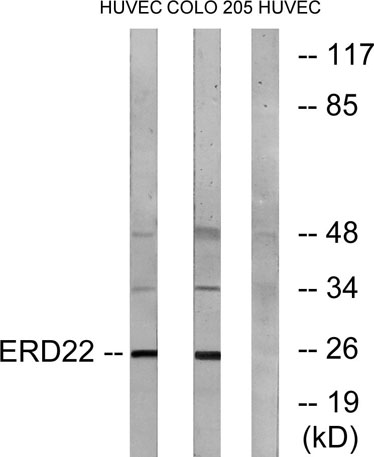
KDEL Receptor 2 rabbit pAb

一鍵復(fù)制產(chǎn)品信息
ES2671
規(guī)格: 價(jià)格:
50μL ¥1280.00
100μL ¥1980.00

Overview

Product name: KDEL Receptor 2 rabbit pAb
Reactivity: Human;Mouse;Rat
Alternative Names: KDELR2; ERD2.2; ER lumen protein retaining receptor 2; ERD2-like protein 1; ELP-1; KDEL endoplasmic reticulum protein retention receptor 2; KDEL receptor 2
Source: Rabbit
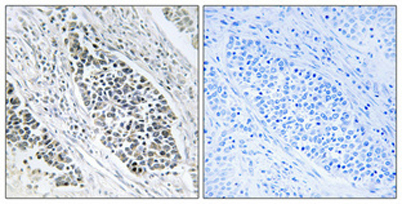
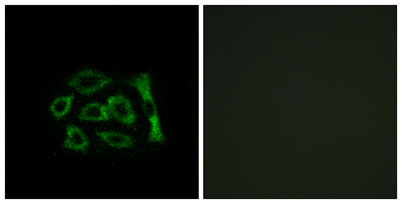
Dilutions: Western Blot: 1/500 - 1/2000. Immunohistochemistry: 1/100 - 1/300. Immunofluorescence: 1/200 - 1/1000. ELISA: 1/20000. Not yet tested in other applications.
Immunogen: The antiserum was produced against synthesized peptide derived from human ERD22. AA range:81-130
Storage: -20°C/1 year
Clonality: Polyclonal
Isotype: IgG
Concentration: 1 mg/ml
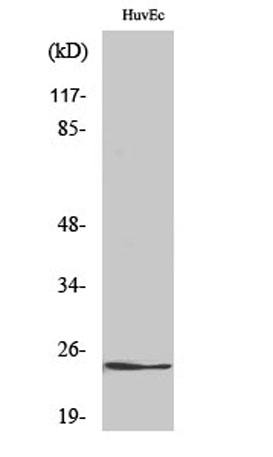
Observed Band: 24kD
GeneID: 11014
Human Swiss-Prot No: P33947
Cellular localization: Endoplasmic reticulum membrane ; Multi-pass membrane protein . Golgi apparatus membrane ; Multi-pass membrane protein . Cytoplasmic vesicle, COPI-coated vesicle membrane ; Multi-pass membrane protein . Localized in the Golgi in the absence of bound proteins with the sequence motif K-D-E-L. Trafficks back to the endoplasmic reticulum together with cargo proteins containing the sequence motif K-D-E-L. .
Background: KDEL endoplasmic reticulum protein retention receptor 2(KDELR2) Homo sapiens Retention of resident soluble proteins in the lumen of the endoplasmic reticulum (ER) is achieved in both yeast and animal cells by their continual retrieval from the cis-Golgi, or a pre-Golgi compartment. Sorting of these proteins is dependent on a C-terminal tetrapeptide signal, usually lys-asp-glu-leu (KDEL) in animal cells, and his-asp-glu-leu (HDEL) in S. cerevisiae. This process is mediated by a receptor that recognizes, and binds the tetrapeptide-containing protein, and returns it to the ER. In yeast, the sorting receptor encoded by a single gene, ERD2, is a seven-transmembrane protein. Unlike yeast, several human homologs of the ERD2 gene, constituting the KDEL receptor gene family, have been described. KDELR2 was the second member of the family to be identified, and it encodes a protein which is 83% identical to the KDELR1 gene product. Alternative splicing r
關(guān)閉

在線咨詢

Online consultation

  • 在線咨詢
  • 技術(shù)支持

關(guān)注微信公眾號(hào)

微信掃一掃立即咨詢

微信掃一掃立即咨詢

關(guān)閉